Dream Job Hunt
On this page
To Do in the First Week
1. Initial Setup
Skim through this Guide
Learn https://www.youtube.com/playlist?list=PL1QBBmOuvLxt2bsWDlP2qGsm3r6Y2k-fH
Set Up a Task Management System in Todoist or an other app of your choice or even paper using https://www.loom.com/share/0ffc812f20e04d66baf1da9dcc0df840
Then Create a Task Management System like so:
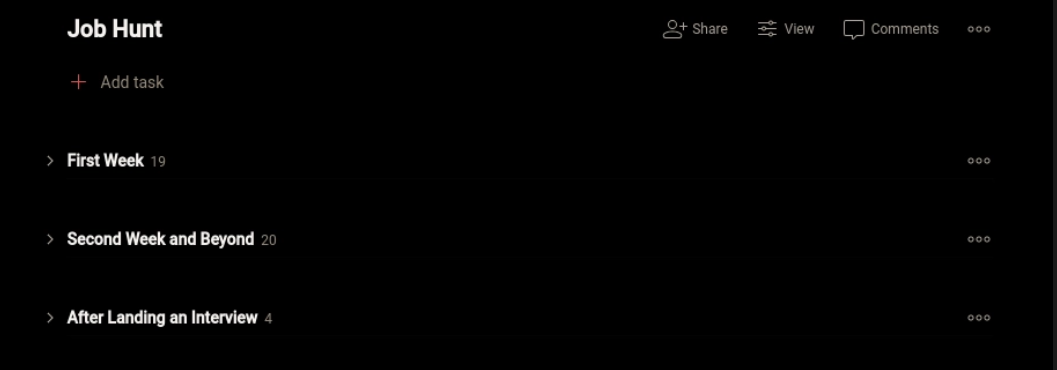
For the First Week section:
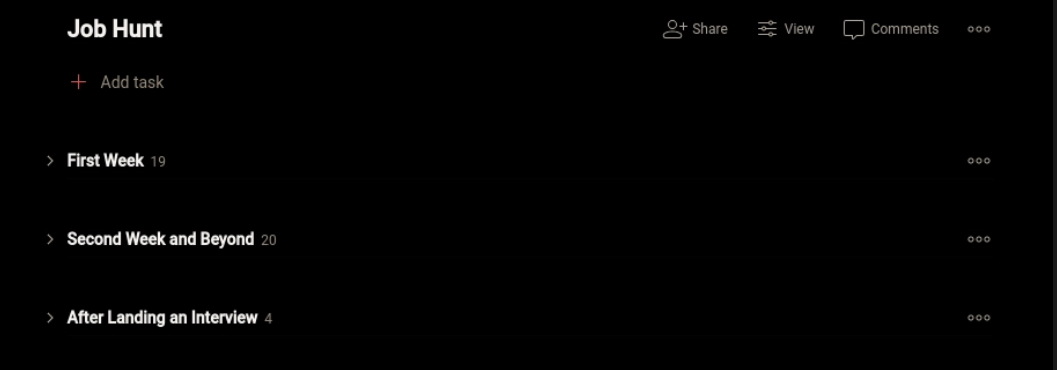
For the Second Week and Beyond Section:
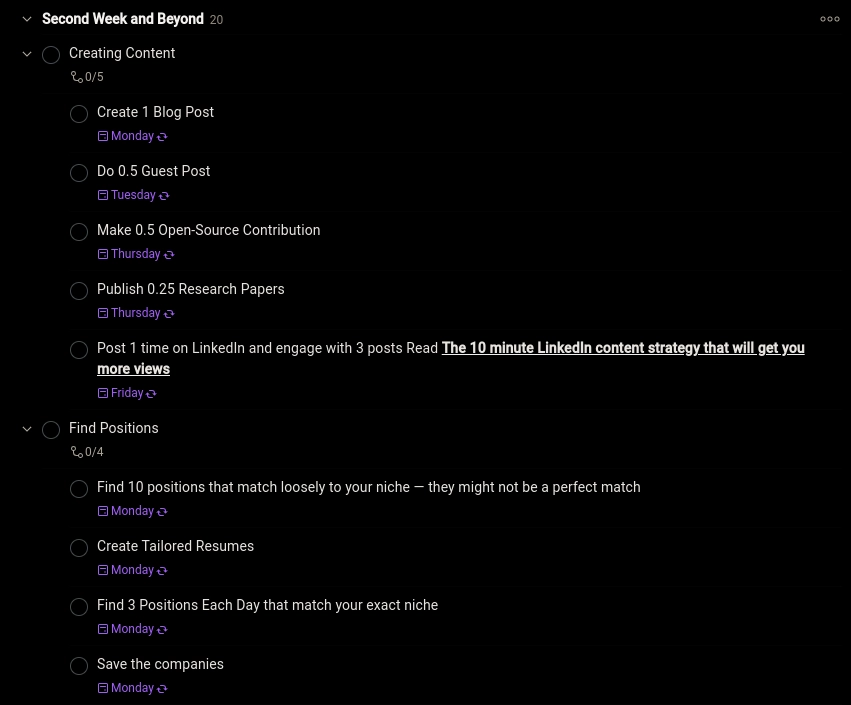
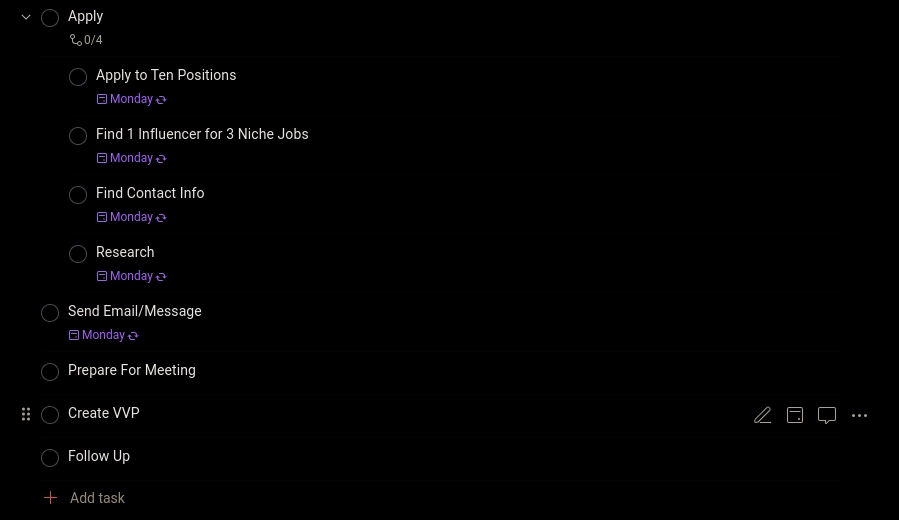
Please note that for each task that has the purple “Monday” due date in it you need to type in “Each Workday from next Monday” as the due date like this:
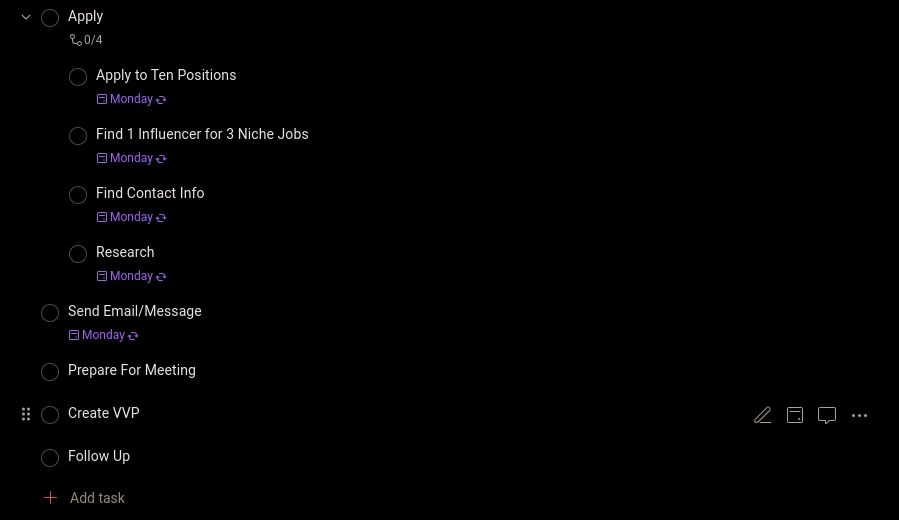
For the last three tasks, leave them without a due date:
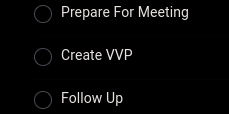
We will add a due date later when these tasks show up in our process.
For the After Landing an Interview Section:
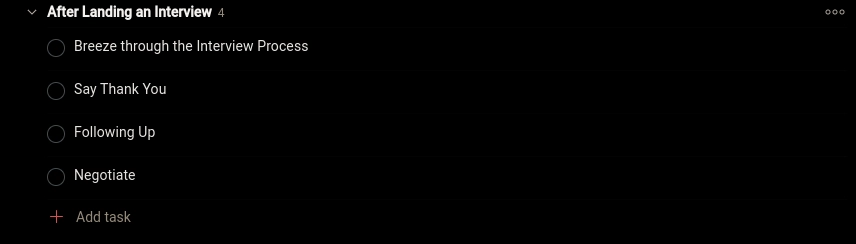
Leave all these without a due date as well.
Now open the Today view from the Sidebar:
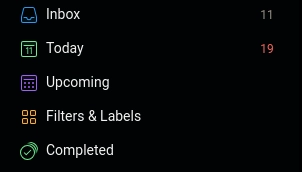
It will show your tasks for Today:

Complete them now! 😎
Watch https://www.youtube.com/watch?v=uWtm70HLMkM&ab_channel=TariqMasoodExclusive
2. Define Your Niche (IMPORTANT)
ℹ️ Start in the end! What does your dream job look like? What’s your ideal career 3-5-10 years from now?
The first step is to understand what success looks like and what we really want. Neglecting this step will get you to interview and work at companies that are not a fit. And this may lead to years or even decades wasted.
So, let’s first define your dream and work backward to get it. And don’t worry about getting it perfect at first; it will evolve over time.
Fill this out:
Define 3 max of each of the following (the fewer the better)
-
Positions (This is called your horizontal expertise) — the more specific the better
- X
- Y
- Z
For example:
- ML Engineer
- Technical Recruiter
- Engineering Manager
-
Industries (This is called your vertical expertise) — the more specific the industry the better
- X
- Y
- Z
For example:
- Education
- Personal Growth
-
Locations (Optional) — If you are choosing remote make sure the working hours are in your time zone. For example, if you are in Pakistan you may choose open positions that are advertised in the EMEA or Asia-Pacific region.
- X
- Y
- Z
For example:
- Islamabad (Onsite)
- Dubai (Remote)
- Malaysia (Remote)
-
The position and industry you choose should be:
- Something you are passionate about
- Something you have experience in
- Something that is sought after in the marketplace
-
If the position and industry are a combination of all three — that is the best!
3. Resume & Cover Letter Building:
ℹ️ Most job seekers think about how to get a job but never consider the person on the other side of the table who is hiring.
Employers traditionally create a scorecard for every position. Check out this resource to understand the process from the employer's perspective.
Now, let’s reverse engineer the scorecard into resume bullet points that will check all the boxes.
Write your resume for each of the niches. These will become your starting templates.
We must start with building one resume for each of our niches.
To make a good resume, read these:
Read https://cultivatedculture.com/resume-action-words/
Read https://www.inc.com/bill-murphy-jr/google-recruiters-say-these-5-resume-tips-including-x-y-z-formula-will-improve-your-odds-of-getting-hired-at-google.html
4. LinkedIn and Online Presence:
Read https://cultivatedculture.com/linkedin-profile-tips/
Watch https://www.youtube.com/watch?v=B4OhuzwLc9o&ab_channel=JeffSu
Then, focus your LinkedIn profile on your most impressive accomplishments. Be as concrete as possible e.g. “ranked third in the nation”, “increased annual donations 100%”. Cut the rest. It’s better to have two impressive achievements than two impressive achievements and three weak ones. Finally, search yourself on Google and do anything you can to make the results look good.
Copy bullet points from your resume that you created using https://www.inc.com/bill-murphy-jr/google-recruiters-say-these-5-resume-tips-including-x-y-z-formula-will-improve-your-odds-of-getting-hired-at-google.html
Online Presence:
Update All Your Social Media to reflect your LinkedIn
Github
Have at least 5 Projects uploaded on GitHub in your niche
Optional: Create Website
You can do this with Wordpress
5. Ask Close Connections:
If you already know someone in the industry who can hire people, then ask for a meeting
to discuss opportunities in the industry. This is close to going directly to an interview, skipping all the screening steps. Remember, there doesn’t need to be an open position – employers will often create positions for good people.
If your connection is not able to refer you, then ask them to introduce you to people in the industry who are able to hire. Then follow step 11.
Note this down somewhere.
6. Connect with Important People
ℹ️ It’s time to research people who are 5-10 years ahead of you. These guys have walked the walk and have achieved what you want to achieve.
You should know who these people are and ask them for advice.
First, they can give you advice on your career path. Is it sound? How does it feel to be in their shoes?
Second, they will tell you great companies you should consider applying to. And maybe even make introductions.
And finally, and most importantly, they may be the people you will want to work with.
To Do Second Week and Onward
7. Creating Content
- Create 1 Blog Post on Each Monday
- Do 0.5 Guest Post Each Tuesday
- Make 0.5 Open-Source Contribution Each Wednesday
- Publish 0.25 Research Papers Each Thursday
- Post 1 time on LinkedIn and engage with 3 posts Each Friday.
If you've never thought about creating content on LinkedIn, getting started can feel overwhelming but it's actually much easier than you think.
Here's a quick process you can use to create content that will get you WAY more profile views in less than 10 minutes per day:
Step 1: Follow The Views
If you want more visibility but don't have a huge following, you need to go where the views are.
I'll bet you've seen those posts from people in your industry with a couple hundred likes and comments. Those posts are racking up tens of thousands of views which means any comments left on them are getting in front of those eyeballs too.
Check out Devin's post here:
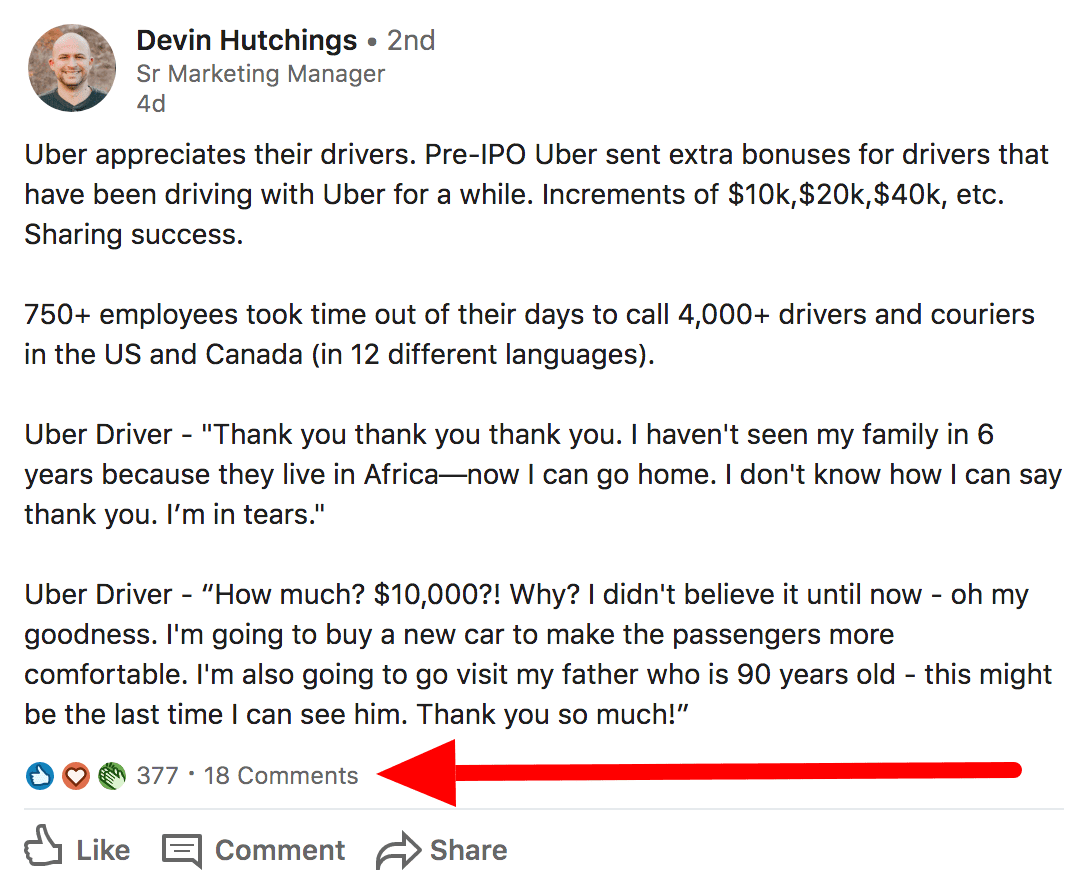
It has 377 reactions, but only 18 comments! This is a huge opportunity to get visibility because this post probably has at least 15,000 views (likely a low-ball estimate) but it doesn't have a ton of comments which means yours is much more likely to stand out.
Step 2: Leave A Thoughtful Comment
The comments section on LinkedIn works like a voting board — the comments with the most reactions, replies, and engagement typically bubble up to the top.
If you're the top comment on a post with 20,000 views, you can bet your comment is going to get a decent number of those eyeballs!
Fortunately for us, most people leave fairly low effort comments on posts. Stuff like, “awesome tips,” “love this advice,” “thanks for sharing,” etc. While those are all great, they're probably not going to make their way to the top.
Taking a few minutes to draft up a thoughtful comment that asks a question, shares additional advice, sparks debate, or adds to the discussion is far more likely to generate likes and replies.
Step 3: Combine For Best Results
All you need to do to begin generating more profile views is combine the two ingredients above and make it a daily habit.
Open up LinkedIn a few times throughout the day and scroll through your feed until you find a post that's gaining traction.
Once you find one, read it a few times and brainstorm a thoughtful comment that adds to the conversation, then post it.
This shouldn't take you more than 10 minutes to do and if you rinse and repeat every day, your profile view count will shoot through the roof!
Pro Tip: The earlier you comment on a post that eventually gains traction, the better. Influencers with big followings on LinkedIn are pretty much guaranteed to have large view counts on their posts so all you need to do are follow them, figure out their posts times, and show up early!
8. Find Open Positions in your Niche(s)
ℹ️ Now that you know what your dream job looks like, it’s time to find dream companies and positions.
This is all about discovering the most promising companies and opportunities. Are you excited about their mission and products? Who would you be working with there? Are these the people you’d like to learn from?
8a. Find 10 positions that match loosely to your niche — they might not be a perfect match.
Save these somewhere.
8b. Create Tailored Resumes:
You need to create 1 for each of the 10 Positions you found.
8b. Find 3 Positions Each Day that match your exact niche:
Save this info somewhere.
9. Apply
🤖 You don’t want to end up in the pile of resumes never-to-be-seen… Competing for a hot position with hundreds of other applicants is an uphill battle. And if you’ve applied to maaaany jobs online with no response already, then this may change everything for you.
There are two ways to go about your application. You should do both to see what works for you.
Method A: Via the Traditional Route
Use this resource to write an effective cover letter.
Method B: Referrals
ℹ️ Method B: Referrals
Here, we are first going to connect with people who have influence over the hiring project. We will seek career advice as opposed to directly asking about a specific position. The insights from those conversations will fuel our Value Validation Project. More on that later. By then, your application process has already begun!
Find Influencers
Now open your notes where you saved the 3 open jobs.
Now, you are going to find someone who not only knows about the role, but could potentially have an impact on hiring for it. Time to fire up LinkedIn.
In the LinkedIn search bar, I want you to plug in the company name from the database.
With that in mind, I usually look for the person with a title that is one level up from the position that I’m looking for. Save this info somewhere.
Obtaining Contact Info
Here are 3 strategies you can use to find almost anyone’s email address:
-
LinkedIn:
It could be present on LinkedIn
-
Reverse Lookup
Head over to Mailscoop and enter the first and last name of the person you are searching for, as well as their company's website.
You can also use Hunter.io or some other tool.
-
Matching Formats
If that doesn’t work, you can try finding someone else’s email at the company and use that format reverse engineering your target email address.Once you have the format, you can use MailTester to confirm your target email address.
Save the info somewhere.
Research, research, research:
Now that you have your potential influencer, it’s time to do some research so you can effectively reach out and build that relationship! Find what you can about them. Save the research somewhere.
10. Sending The Email
Hopefully, your research uncovered an angle you can use to personalize the email and make the outreach about them. This could be something like:
- A non-traditional background
- An interesting career pivot or move
- A current project they're working on
- An article they wrote
- Something from their personal website
For example, if you were going to email me, you might dial into the fact that I transitioned from healthcare into the tech space.
Here's the email you'd write for that:
Subject: Quick Question
Hi Austin,
My name is [Your Name] and I found your info while I was looking for people who made the jump into tech from a non-traditional background. Your experience transitioning from healthcare to Microsoft really stood out to me.
I'm sure that transition wasn't easy! I'd love to hear more about your journey, some of the obstacles you faced, and ask you a few questions.
I know you're busy and your time is valuable, no need to respond in depth. If you do have a few minutes to chat, I'd be really grateful. If not, no worries! Either way, have a fantastic week.
Best,
Haseeb
Let's pretend that I’m reaching out to Tim who works at Google, but doesn't have a lot of info online. Here's what I'd write:
Subject: Quick Question
Hi Tim,
My name is Austin and I currently work at Cultivated Culture. I was browsing through LinkedIn and came across your information – I hope you don’t mind me reaching out of the blue here.
I saw that you have extensive experience in Google’s Technology B2B vertical and I’m very interested in learning more about that space. I would love to have the opportunity to run some questions by you, as well as tap into any advice you may have given your knowledge of the industry.
I know that your time is extremely valuable so please don’t feel to need to respond in depth. If you do have 5 minutes to chat, I would really appreciate it.
Best,
Austin
There are a few key points to the emails above:
- Address the person you are emailing by name
- State who you are and make it personable
- Include some flattery that positions the person as an “expert”
You can also contact them directly on LinkedIn.
11. Prepare For Your Meeting
In order to prepare, we have to know what we’re preparing for. The goal of your meeting is to position your influencer as an expert, make them feel special, and build a relationship.
You will not and should not mention anything about the opening at their company. People innately enjoy helping others and if you follow the steps above, they will bring this up naturally.
You will want to prepare a list of questions that gets them to open up about themselves and the company. I like to ask them several softballs to get things warmed up and then hit them with a few questions they are guaranteed to remember.
Here is a quick set that I’ve had success with in the past (I've found the last one really seems to stick):
- I saw you worked at [Previous Companies]. How did you end up going from [First Industry] to becoming interested in [Current Company]?
- You hear a lot about [Current Company] in the news, but I’d love to hear more about why you love working there. What’s your favorite part?
- What is one totally unexpected lesson you’ve learned from working at [Current Company]?
The “Million Dollar” Question
Regardless of the questions you choose, there is one that you must always be sure to ask:
“What is the biggest challenge your team is facing right now?”
Really dig in here, get them to be specific. This information is going to be critical in helping you land a referral from this person, as well as getting the offer further down the road.
I like to ask them several softballs to get things warmed up and then hit them with a few questions they are guaranteed to remember.
Here is a quick set that I’ve had success with in the past (I've found the last one really seems to stick):
- I saw you worked at [Previous Companies]. How did you end up going from *[First Industry]*to becoming interested in [Current Company]?
- You hear a lot about *[Current Company]*in the news, but I’d love to hear more about why you love working there. What’s your favorite part?
- What is one totally unexpected lesson you’ve learned from working at [Current Company]?
Ask them advice, note it down.
If it goes well, ask them to introduce you to people who may be able to hire you, which is effectively getting a referral from this person. Do not ask them for a job if you promised it was an informational interview.
12. Prove Your Worth With A Value Validation Project
VVPs are kind of like a resume on steroids. You find a pain point or opportunity, then you create a deliverable that illustrates:
- The research you've done on the company
- The problem or opportunity at hand
- Solutions or ideas to help the company win
- Your background as evidence for why you're the best person to execute on these ideas
Over the next week you are going to research the crap out of your influencer's problem. Then you are going to come up with a solution and draft up a proposal for how you would solve it. Your proposal should include:
- A summary of the problem (to illustrate that you understand their pain)
- A step-by-step framework of how you would solve this problem
- A brief outline of how your skill set positions you as an asset to implement that solution
Check out this article with 12 VVP example.
Explore Austin’s starter kit with examples, references, and tutorials to create a great Value Validation Project.
Get The Value Validation Project Starter Kit - Cultivated Culture
The Format
Presentations in Google Slides or PowerPoint are great for this.
That said, the best medium you can use is the one that you feel the most comfortable with and is the most relevant to your target job.
If you want to break into video production, a short film might be a better option. If you want to be a software engineer, coding out a project is probably a good bet.
13. Following Up With Your Proposal
Now we're going to reach back out to our influencer with the proposal.
Here's the template I used:
Hi [Influencer],
Thanks again for taking the time out to chat last week!
I spent a lot of time thinking about what you said regarding [team's biggest challenge]. In fact, I created a short framework that should help you solve it! Please find that attached.
If you have some time, I would love to chat about it in more detail.
Please let me know if you have any questions, I'm looking forward to hearing your thoughts!
Best,
Austin
When they do get back to you, they will not only bring up the opening but they will ask you if you're interested. Kindly accept and play it cool. You’re in!
To Do after Landing the Interview
14. How To Breeze Through The Interview Process:
One of the easiest ways to be a better interviewer is to prepare for the most obvious questions.
99% of the interviews you go on will follow the exact same template. If you can master the format, your confidence will skyrocket and you'll be prepared for almost any situation you get thrown into.
The pre-interview project
- Find out what you’d be doing in the role (this already puts you quite a way ahead).
- In particular, work out which problems you will need to solve for the organisation. To figure this out, you’ll probably need to do some desk research – here’s a simple guide – then speak to people in the industry.
- Spend a weekend putting together a solution to these problems, and send them to a couple of people at the company with an invitation to talk more.
- If you don’t hear back after a week, follow up at least once.
- Alternatively, write up your suggestions, and present them at the interview. Ramit Sethi calls this “the briefcase technique.”
The Universal Job Interview Format:
1. Tell Me About Yourself!
This is your first impression. More importantly, it’s the only part of the interview that you totally control. Do NOT rattle off your resume like a grocery list.
In order to nail this part you need to craft an interesting story – your story. You want it to be concise (around 2-3 minutes) and you need to think about what you want to convey. I recommend:
- Choosing 2-3 themes to build your story around (for me, those themes were Persistence, Agility, and Success)
- Including quantitative metrics whenever possible
- Addressing the question of why you want to leave your current position (they are going to ask you this anyways, addressing it early shows that you're aware it's a concern of theirs and helps put them at ease)
To help get you started, here is what my story looked like. To give you some context, I was a biology major who was interested in landing a job in digital marketing:
Growing up, like most people, I wanted to be a doctor. I went to [college] where I majored in biology and planned my course to medical school. Not long after, I decided that pre-med wasn’t for me. I wanted to get into digital marketing, and I wanted to be in New York. I set my sights on this goal and created a plan that would get me there.
In 2013, I graduated with my biology degree and took a job in medical device sales where I worked from 5:30am – 12:30pm covering surgical cases in the operating room. Then, every day, I would come home and study digital marketing until 8:00pm. In order to gain relevant experience, I got certified in Google Analytics & AdWords and created my own consulting firm that focused on using search engine marketing to generate leads for private golf communities. We were able to increase home sales by an average of 20% while reducing the cost per lead by around 10%. Armed with my new credentials, I began to look for positions in New York.
Eventually, I was offered a position at my current company (a promotional analytics company in New York). During my tenure there I have grown my book of business by 467%, spearheaded the creation of an internal group dedicated to marketing the company on the internet, and helped close the 2nd largest deal in company history.
However, the company has restructured several times since I was brought on. I've had 3 different managers over the past year, as well as 3 titles with different sets of responsibilities. I'm looking for something a bit more stable and has been somewhere that I have wanted to work since I got into this industry. I'm really excited to have this opportunity.
Pro Tip: You are telling a story. Don’t be afraid to embellish a bit. I’m not saying you should lie or make up stories, but you want to sell yourself and you can bet your butt that your competition isn’t afraid to inflate their credentials. It doesn't hurt to practice either. As blogger Ryan Robinson adds, “rehearsing and building upon my story over the years, is one of the ways I've honed my ability to write a blog post that tells a compelling narrative about why my clients should hire me.”
2. Behavioral Questions
Next up is the dreaded set of behavioral questions. The ones meant to tease out your thought process and your ability to be a “team player,” as well as why you're interested in this specific role. This is the part where our educated “guesses” are going to come in handy.
The behavioral section is broken down into two parts that I call _Standard Questions_and Company Specific Questions. Let's start with the former.
Standard Questions
You are going to be asked a variation of one, if not all, of these questions in every single interview you go to:
- Why do you want to work for us?
- Tell me about a time you exhibited leadership
- Tell me about a time where you had to work as a team
- Tell me about a time you've had to work with a difficult person, or difficult people
- Tell me about a time you failed
- Tell me about a time you overcame an obstacle
- Tell me about a time when you had success
If you can answer these 6 questions, you could handle 9 out of 10 interviews with no other preparation and be totally fine. Just follow the same set of rules I mentioned above in the _Tell Me About Yourself_section:
- Craft a concise story
- Make sure to include quantitative metrics that illustrate your success
- Anticipate and address objections
Company Specific Questions
These are questions that fall in the middle of the 7 listed above and “why are man hole covers round?” Never fear though, we can anticipate these too.
Head over to GlassDoor. If you've never heard of GlassDoor, it's a great resource for any job seeker that includes salaries, reviews, and interview information for almost any company in the world.
First, you are going to search for the position you're applying for. In keeping with our theme, we'll search for “Google” under Companies & Reviews:
Next, we're going to click on the “Interviews” Tab:
Then scroll down and click on “Filter Interviews” which will bring up some advanced settings. Here we'll type in the title of the job we want (Account Manager, in this case) and the location (New York, NY). We'll also select “Received Offer” because the people who didn't receive offers tend to be slightly, ahem, biased:
This will pull up a list of reviews from everyone who interviewed and received an offer for that position. The general comments are really helpful, but we want to focus on a section called _Interview Questions_towards the bottom. I usually comb through 10 – 15 of these and add all of the interview questions into a Word doc so I can answer them later:
Now you have your second set of questions to prepare for!
3. What Questions Do You Have For Me?
Finally, once they are done peppering you with questions, your interviewer will ask if you have any questions for them. In my opinion this is the most crucial part of the interview.
Why? Because so many people neglect it. If you can ask some questions that are even slightly outside of the box, I've found that really sticks with the interviewer more than any other part of the meeting.
After every interview I've been on, I asked for feedback. Without fail, the interviewer made a positive comment about the questions I asked. The good news for you is that I asked the same exact questions in every single one! Here they are:
- What is your favorite part about working here?
- What is the biggest challenge you are facing right now?
- Let’s say that in one year, you are looking back on this hire. What has that person done to exceed expectations on every level?
- Ask about a current event (for example – I saw that [Competitor X] came out with this product. How do you see that affecting your business?)
- What is the most unexpected lesson you’ve learned while working at ?
- Tell me a little bit more about you, what do you like to do outside of work?
The first four are fairly standard questions, but the last two really seal the deal. Don't be surprised if you get a “wow, I've never been asked that – give me a second” when you drop the unexpected lesson.
Things to Do:
- When you meet an employer, ask lots of questions to understand their challenges.
Discuss how you might be able to contribute to these challenges - Prepare your three key selling points ahead of meetings. These are the messages you’ll try to get in during the discussion. For instance: 1) I have done this work successfully before, 2) I am really excited about this company, 3) I have suggestions for what I could work on.
- Focus on what’s most impressive. What sounds better: “I advised Obama on energy policy” or “I advised Obama on energy policy, and have worked as a high school teacher the last three years”?
- Prepare concrete facts and stories to back up your three key messages. For instance, if you’re applying to be a web engineer, rather than “I’m a hard worker”, try “I have a friend who runs an organization that was about to get some press coverage. He needed to build a website in 24 hours, so we pulled an all-nighter to build it. The next day we got 1,000 sign-ups.” Rather than say “I really want to work in this industry”, tell the story of what led you to apply. Stories and concrete details are far more memorable than abstract claims.
- Work out how to sum up what you have to offer in a sentence. Steve Jobs didn’t sell millions of iPods by saying they’re 30% better than mp3 players, but rather with the slogan “1,000 songs in your pocket”. Having a short, vivid summary makes it easy for other people to promote you on your behalf. For instance “He’s the guy who advised Obama on climate policy and wants a research position.”
- Practice the meeting, from start to finish. Meet with a friend and have them ask you five interview questions, then practice responding quickly.
You can research the company’s interview process on Glassdoor.
- https://almanac.io/docs/interview-prep-answer-interview-questions-with-key-results-cF4TwddXLtvGbfSjAyKEk8EPRLN2ktmk
- https://cultivatedculture.com/how-to-get-a-job-anywhere-no-connections/
- https://almanac.io/docs/job-interview-prep-hiring-manager-and-panel-interviews-MMgVflUJg315rse1nWcVskeyb8d1I5S7
15. Say Thank You!
While we're on the subject, be absolutely sure to send a thank you email to everyone you interviewed with. Also include a personal touch to each one (something that you gained from that last question).
16. Following Up & What To Do If They Say No
The rule of thumb for following up after an interview is one business week. If you interviewed on a Tuesday, wait until the next Tuesday to email them (as JT O'Donnell says, never send a nudge on a Monday!). When you do, don't push or be blunt. Keep it short and sweet:
Hi [Interviewer],
I hope you had a great week!
I wanted to quickly follow up and see if there was anything else I could help with regarding the application process. If so, please let me know!
Best,
Austin
That's it. If they don't respond to that after another 3-4 days, you have your answer and it's time to move on.
What Happens If They Say No?
Ugh. The worst case scenario. Don't get down just yet though, we're not done here!
I have this quality where I have trouble accepting “no” as an answer. When I was interviewing with Google, the initial screener told me that she wasn't going to put me through because she “didn't think I was qualified, and didn't want to waste the team's time.”
I was not happy. So I sent her this:
Hi [Recruiter],
Thank you again for carving out the time to speak this afternoon. I really appreciate your feedback, and I wanted to add one final note:
I completely understand your concerns regarding my experience with [skill]. You are correct that I didn't have much experience with that at [previous company]. That said, this doesn't stem from an inability to produce results, but rather a lack of opportunity to do so.
While my experience on paper may not match up to the initial expectations of the position's description, I have do have two qualities that work in my favor: I am an extremely efficient learner, and am also very effective at translating those learnings into practice. Second, I'm much more tenacious than your average individual. My career has hinged on these two qualities.
I left college with no digital experience and a biology degree – all of my digital knowledge was obtained through self study. I spent 8 months selling myself without the on-paper experience to back it up. When I was finally given the opportunity to apply my knowledge in a business setting, I playing a critical role in landing the company's 2nd largest deal in history. I am confident that I can have the same success in this role. I have the resources necessary to learn what I need in order to be successful at , and am prepared to do whatever it takes to make that happen.
I understand that interview process is extremely challenging, and that only the top talent ends up with an offer letter at the end. I also believe that I am worthy of a shot at that letter. [Company] is known for hiring people who excel at the intangibles, as well the ability to learn new things and apply them to existing knowledge. That is my forte.
I am not asking for an offer. I am simply asking for the opportunity to speak with the hiring manager to make my case for the position. I'm sure you will find the best person for the position, I would just like to have a legitimate shot at being that person. If you give me that chance, my next set of answers will not disappoint.
_Thank you again for your continued consideration.
Best
Austin
17. How to negotiate:
Negotiation should be most strongly considered when you have more than one good offer, because then you have a strong fallback position.
Explain the value you’ll give the employer, and why it’s justified to give you the benefits you want. The idea is to look for objective metrics and win-win solutions – can you give up something the employer cares about in exchange for something you care about? For instance:
- I’m going to redesign your sign up process, increasing the conversion rate by 1%, which is worth millions of dollars to you, so I’d like to be given donation matching up to $50,000. This is something I value, and the company can claim tax benefits on the donations.
- Other people with my level of experience in this industry are usually paid $50,000 and can work at home two days per week. But I’d prefer to work with you. Can you match the other companies?
- I’m really motivated to learn sales skills, so I’d like to work alongside person X. This will make me much more effective in the role in six months.
Negotiate after you’ve started
Once you start the job, try to perform as well as possible, and then negotiate again. Most employers will be very unwilling to lose someone who’s already doing excellent work. Just bear in mind, most companies have a standard review process, so wait until then to make your ask.
Connections
Linked from
Local graph
Comments
Sign in with GitHub to comment or reply. Comments are stored as GitHub Discussions.